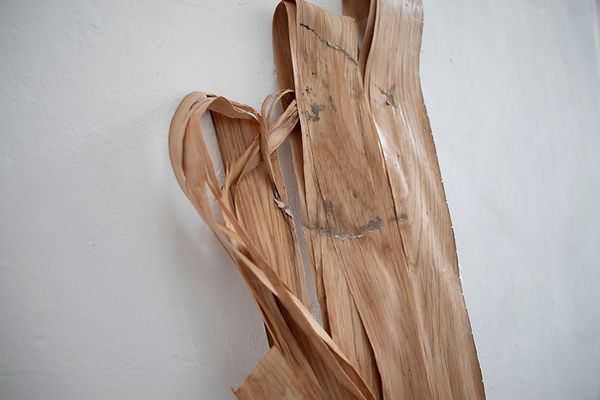
Live performance & Sculpture
10x30x120cm
This work intervenes in the bentwood-making process through the body, repositioning how materials come intobeing and situating this act within broader histories of power. In contrast to traditional bentwood techniquesthat rely on tools and technical precision, the work replaces tools with the body, transforming bending from atechnical operation into an embodied generative process.
This shift emerges from a reconsideration of material ontology. Anthropologist Tim Ingold proposes that “makingis a correspondence between maker and material”, ” materials think in us, as we think through them”. Ifmaterials are not static objects but entities that unfold through interaction, then making is no longer merely theproduction of form, but a temporal unfolding. By turning fabrication into action, the work makes the resistance,contingency, and generativity of material perceptible.
Through my background in woodworking and craft, I worked extensively with the cold-pressed bentwoodtechniques of Alvar Aalto, the Finnish pioneer of modern furniture. I produced furniture and sculptures within astrict craft logic defined by precision, control, and the elimination of failure. Only when I began to set tools asideand work directly with my body did this relationship begin to shift. As control gradually loosened, making ceasedto be an act of domination and became a state of coexistence with material. Unpredictability, delay, and rupturewere no longer errors to be corrected, but conditions of the work itself. In that moment, I was no longer merelyan operator, but became part of the material process.
Yet bentwood itself is a highly structured technique. It relies on moulds, pressure, and prolonged labour. Woodfibres follow directional grain, and bending entails a forced deviation — redirecting material without breaking it,and ultimately fixing it into stability.
This process evokes colonial histories. Colonisation similarly operates through enforced redirection: shiftingbodies and cultures away from their original trajectories under regimes of stability and order. Bending thusbecomes more than a formal operation; it becomes a structural metaphor for how integrity is maintained underpressure while transformation is imposed.
At the same time, bentwood is transformed into a historical metaphor within the work. In modernist designdiscourse, bentwood is often celebrated as a symbol of technological progress. This work, however, reframesbending as a field of forces — a condition in which material is gradually redirected under sustained pressure.Such material conditions resonate with postcolonial contexts, where landscapes and cultures are reshaped overlong durations rather than abruptly replaced.
By applying bodily force directly onto material, the work not only redefines methods of making but alsotransforms sculptural temporality. The final form no longer exists as a completed object, but as the residue of anaction. Sculpture thus shifts from a singular entity into a process distributed across gesture, duration, and trace.In this sense, the curve is not merely a formal outcome, but a conceptual device that reveals how pressure,memory, and history sediment within matter.

The work does not conclude with the performance.It is only completed the following day, when theglue dries and the wood solidifies into place.
This delay allows time to unfold within the work,mirroring colonial processes of gradual assimilationand stabilisation.